Overcoming Your Bank’s Biggest HR Workforce Challenges:
Insights & Recap from the 95th TBA HR Conference
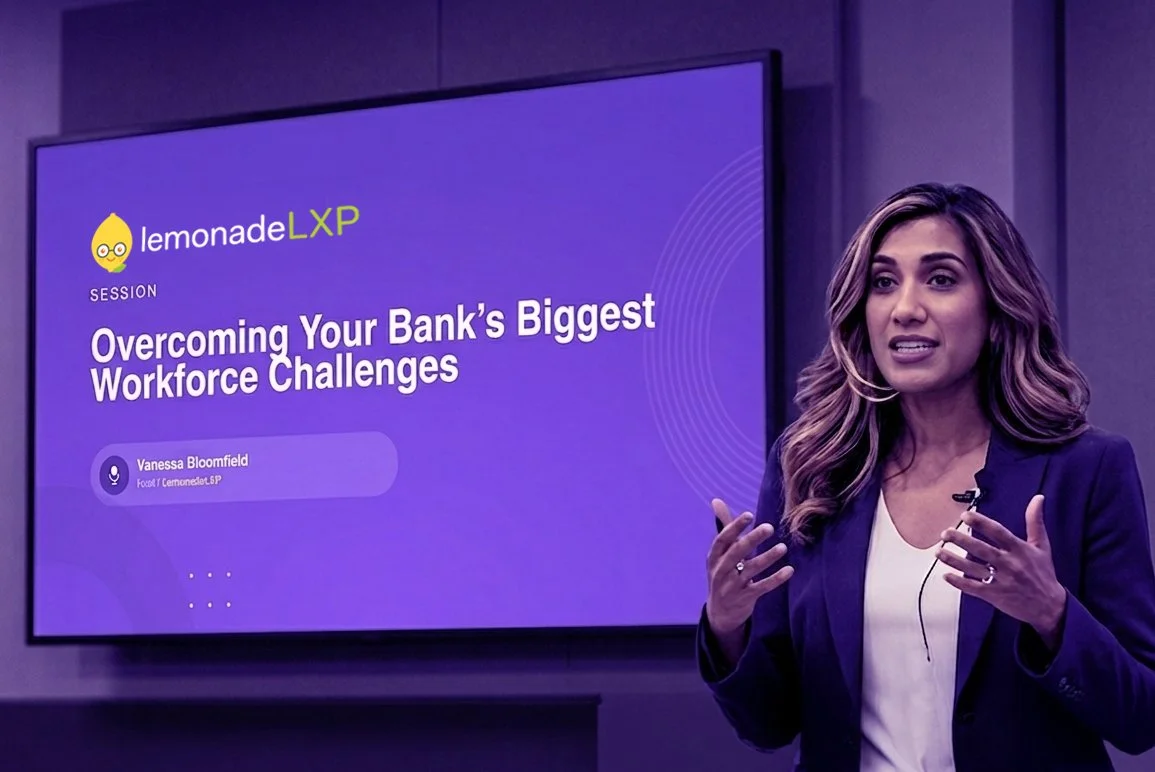
I recently had the privilege of attending the 95th Annual Texas Bankers Association (TBA) HR Conference in Lakeway, Texas, where I hosted a session on a topic near and dear to my heart: Overcoming Your Bank’s Biggest HR Workforce Challenges.
Before joining LemonadeLXP, I spent my career in HR, L&D, talent acquisition, and change management. Because of that background, I still look at every conference through an HR lens. Sitting in on sessions, participating in huddles, and chatting with CHROs, HR directors, and bank leaders, one clear theme emerged throughout the entire conference:
The future of HR is not about replacing people with AI—it is about creating workplaces where people want to stay, grow, and lead.
While AI was discussed in almost every room, the focus was on using technology to reduce administrative work so HR teams and managers can spend more time developing people, building leaders, strengthening culture, and creating meaningful employee experiences. Across nearly every session, one consistent message stood out: the organizations that will thrive in the future are those that intentionally invest in their people.
Below is my recap of what I learned, what I shared, and the key themes shaping community banking workforces right now.
Download My Presentation: “Overcoming Your Bank’s Biggest HR Workforce Challenges.”
Whether you missed the live session or want a resource to share with your executive team, you can download my complete presentation for free:
Key Takeaways from the 95th TBA HR Conference
1. Retention Is the New Priority
Retention was easily one of the biggest topics at the conference. Many banks are finding it increasingly difficult to attract and retain quality talent, particularly for frontline roles like tellers.
Today’s workforce—especially younger generations—is looking for much more than a paycheck. They want clear career paths from day one, purpose, ongoing learning, and rapid growth opportunities.
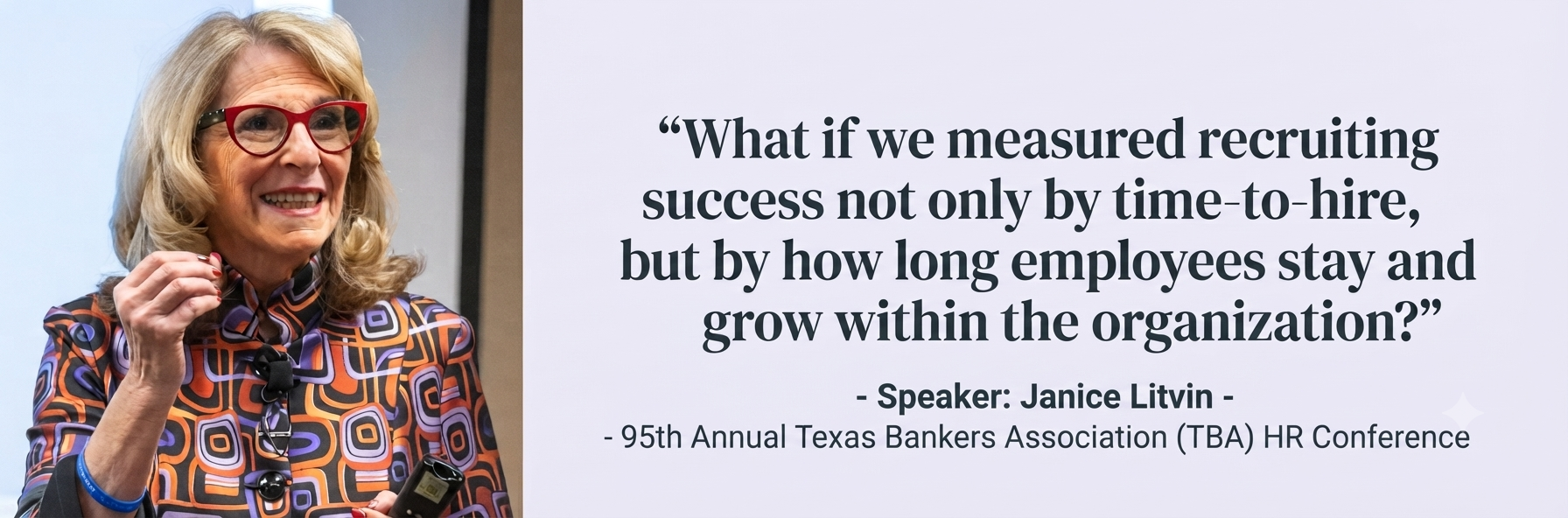
One of the most thought-provoking ideas shared by keynote speaker Janice Litvin was:
What if we measured recruiting success not only by time-to-hire, but by how long employees stay and grow within the organization?
Another concept I loved was introducing stay interviews early in an employee’s journey, rather than relying on exit interviews when it's already too late.
Keynote speaker Carmen Schwab reinforced that retention begins with relationships. She spoke about making "relational deposits" through recognition, coaching, listening, and feedback. When leaders consistently invest in people, accountability and performance conversations become much easier because trust is already established.
2. Leadership Development Is Critical
A recurring message was that leadership can no longer be an afterthought. In community banks, high-performing individual contributors (like great tellers) are often promoted rapidly into management roles, but they aren't always given the tools or training to manage people.
Successful leaders today need:
Emotional intelligence and empathy
Coaching skills
Strong communication
The ability to recognize burnout
Carmen Schwab summarized this beautifully: leadership today is less about directing work and more about developing people. Great leaders create growth by helping employees see potential in themselves that they may not yet see.
3. The Workplace Has Changed
Leaders are navigating a very different environment today—multigenerational workforces, rapid AI adoption, decentralized teams, and higher employee expectations around flexibility and culture.
Speakers repeatedly emphasized that we cannot solve today's workforce challenges using yesterday's approaches. Employees expect coaching, purpose, and growth opportunities rather than simply completing assigned tasks.
4. Where Banks Are Struggling
Several common pain points surfaced in almost every conversation I had:
Leaders spend too much time managing day-to-day operations.
Managers are answering questions all day instead of coaching.
Departmental knowledge sharing is limited (often fragmented across SharePoint folders).
Institutional knowledge is concentrated in a small number of experienced employees.
This is closely aligned with my session on knowledge transfer. During the huddles, I asked how many people have experienced leaders planning to retire in the next five years, and half the room put their hands up! Experienced employees will walk out the door with decades of knowledge if we don't capture it now. As a result, managers become human help desks rather than coaches.
5. AI Should Enhance the Human Experience (Not Replace It)
I noticed an interesting contrast across banks regarding AI. Some leaders are nervous because they don't have an AI policy yet and have valid questions about security and trust. Others are all-in.
The consensus was clear: AI should create more opportunities for leaders to connect with employees—not fewer. AI can improve efficiency in administration and content creation, but human connection, coaching, and authentic conversations remain the foundation of engagement and retention.
6. Build a Culture of Continuous Learning
Learning should not be limited to onboarding or annual compliance training. Organizations should embed learning into everyday work by:
Incorporating learning moments into regular huddles and team meetings.
Encouraging peer-to-peer knowledge sharing.
Creating visible career paths.
Providing ongoing coaching and development.
Building a culture of learning increases employee confidence, improves consistency, and reduces dependency on a handful of experts.
Several speakers reinforced that employees want to understand not only what they do, but why it matters. Helping employees connect their daily work to a larger purpose increases engagement, confidence, and long-term commitment.
7. Engagement Is Built Through Leadership, Not Perks
A common misconception challenged throughout the conference was that engagement comes from occasional perks or social events. Instead, employees remain engaged when they have strong communication, regular recognition, clear growth opportunities, and managers who genuinely invest in their development.
One staggering statistic shared at the event: Only 20% of employees are engaged overall.
“Only 20% of employees are engaged overall.”
This statistic reinforces how massive the opportunity is for community banks to stand out by improving the employee experience. As Schwab reminded us, employees may forget what was said or done, but they will always remember how you made them feel. Authentic recognition and belief in your people are the moments employees remember most.
Frequently Asked Questions
Q: How can lean HR teams build clear career pathways when we don't have extra time?
A: You don't need to spend months creating complex manuals from scratch. Lean HR teams can leverage smart learning platforms and AI-assisted tools to digitize procedure guides, turn heavy documentation into microlearning modules, and map out visible career paths without adding administrative strain.
Q: How do we capture institutional knowledge before our long-tenured employees retire?
A: Don't wait for an employee's retirement notice. Banks need a centralized knowledge base where operational wisdom, policies, and procedures are captured continuously and made easily searchable. This removes single-point dependencies on key individuals and turns institutional knowledge into a shared asset.
Q: Is AI safe and compliant for community banks to use for training and internal knowledge?
A: Yes, when using platforms designed specifically for financial institutions. At LemonadeLXP, for example, we provide a dedicated Trust Center to answer all due diligence, security, and data storage questions. Because these tools house internal operational procedures and learning content—not customer financial data—banks can safely harness AI to boost efficiency.
The Final Squeeze: Why LemonadeLXP?
In my role at LemonadeLXP, I often see two parallel conversations in community banks:
CEOs & Executive Teams tell me about growth strategies, customer experience, and vision.
HR & L&D Leaders tell me about execution, workload capacity, and needing time to develop people.
Both groups are asking for the exact same thing: We need our people to be ready for what's next.
Growth strategies only reach the customer through employees who are trained, confident, and supported. LemonadeLXP bridges this gap by:
- Centralizing Knowledge: Replacing messy SharePoint drives with a single, searchable source of truth for bank policies and procedures.
- Building Employee Confidence: Delivering engaging micro learning that turns training completion into true frontline confidence.
- Freeing Managers to Coach: Eliminating the operational noise so managers spend less time answering repetitive questions and more time developing future leaders.