

4 Ways AI is Transforming Retail Banking L&D and Frontline Enablement
ON-DEMAND WEBINAR

Part 1
Empowering the Frontline: How AI Closes the Knowledge Gap
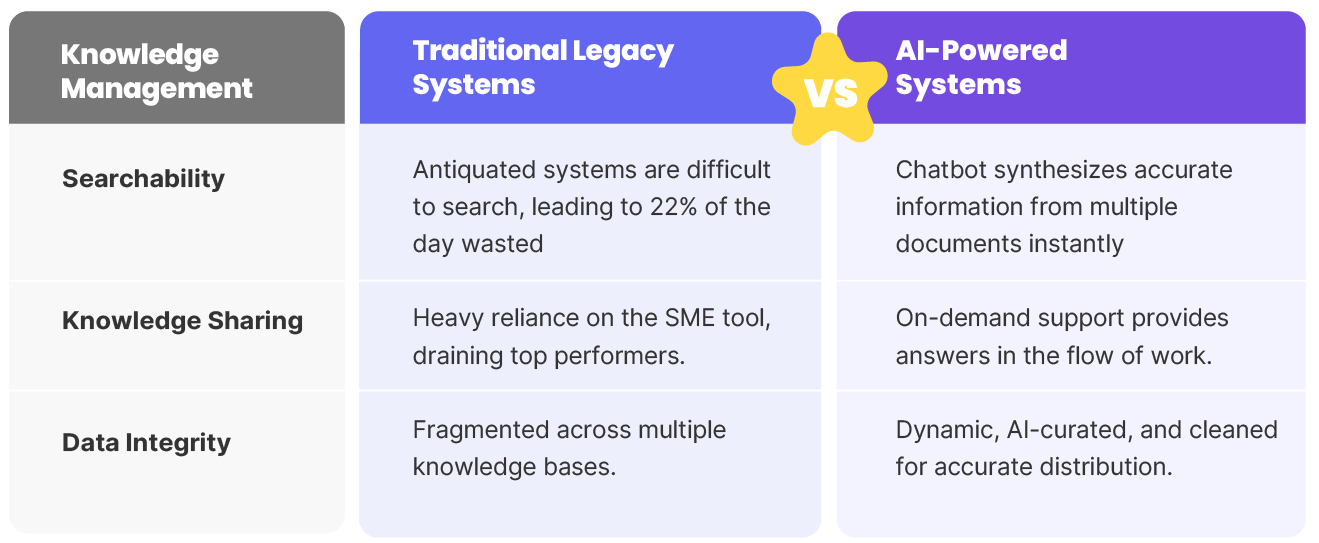
Financial institutions are losing up to 22% of a staff member's workday to inefficient searches within antiquated, legacy knowledge bases. We can solve this by using AI to securely synthesize complex documentation into instant, accurate answers right in the workflow, completely eliminating the reliance on subject matter experts.
So here’s what we hear from our banks and credit unions; fragmented knowledge creates a massive ripple effect across their bank or credit union. It impacts everything from the employee and customer experience, to compliance, and to overall growth. When you think about it, it makes perfect sense; most financial institutions’ staff is distributed across multiple branches and offices. When your team is that spread out, nailing down the unified messaging and service needed to deliver a great customer experiences is an uphill battle.
So what happens?
Staff can't easily find answers in your legacy systems so they either guess, or they pester Mary, your resident expert who knows everything about the business. Not exactly ideal since it drains your most valuable employees’ time, and it leaves you completely exposed if those experts ever leave the organization.
Here’s where AI really shines. It lets you simply drop your documentation (think policies, product info, playbooks, regulations, etc.) into a private, secure knowledge base, which staff can then query using a chatbot. Cuz AI’s super smart, it’ll synthesize answers from multiple documents, something humans aren’t all that great at doing.
Imagine a scenario like this: A banker wonders if they should charge the $15 rush shipping fee for a lost debit card if the customer has a "Premium" checking tier. The AI synthesizes your debit card replacement procedures with your premium account fee schedule to confirm the waiver and provide the exact fee-reversal code, avoiding a situation where they frustrate the customer by wrongly suggesting that they will incur a $15 fee. That's the kind of customer service impact AI can have.
Comparing Legacy Knowledge Bases to AI-Powered Systems in Financial Institutions
Part 2
From Months to Weeks: Accelerating Bank Onboarding with AI
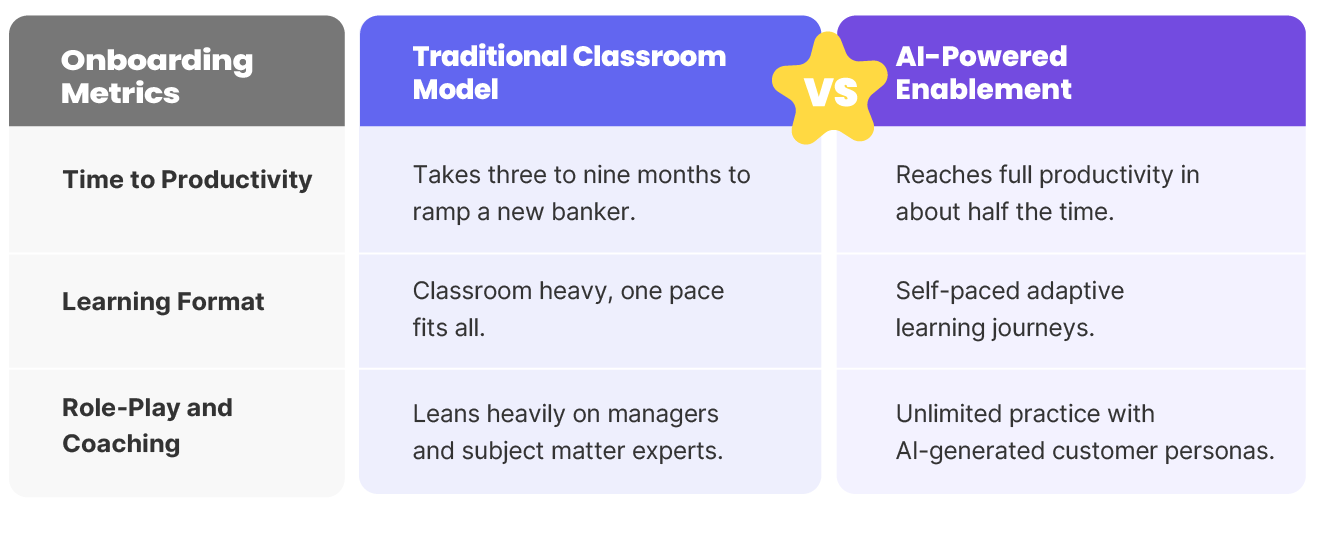
Replacing a banker costs 0.5 to 2 times their salary, with traditional onboarding delaying full productivity by three to nine months. AI cuts this ramp time in half by completely reimagining the learning journey; giving new hires instant access to information in the flow of work, personalizing their training paths, and letting them practice real-world scenarios before they ever serve a customer.
We all know high turnover is a massive problem in the industry. Empty seats create scheduling gaps, impose busy work schedules for existing staff and can impact your customer experience. Worse!; traditional onboarding is classroom-heavy, leans on a one-pace-fits-all model, and demands excessive shadowing that eats up your managers' time. It’s no wonder we're seeing high early attrition…over 30% in year one.
When you look at the actual economics, the direct cost takeout of using AI for L&D is really hard to ignore. AI-powered onboarding lets you ramp new staff members to full productivity in about half the time. And it does this by attacking the onboarding bottleneck from a few different angles:
Information in the Flow of Work: Instead of forcing new hires to memorize everything or constantly tap a manager on the shoulder, AI acts as a safety net. They can use a chatbot to instantly find and synthesize answers right when they need them. It gives the frontline the knowledge and confidence they need on day one, without the fear of making mistakes.
Self-Paced, Adaptive Learning: No more one-size-fits-all classrooms. AI acts as a 24/7 mentor that identifies a new hire's knowledge gaps and addresses them in real-time. Plus, managers get real-time dashboards to see exactly how those new hires are doing and where they need extra support.
Interactive Role-Play: You can quickly spin up AI-generated customer personas; like an anxious elderly customer trying to wire $10,000 overseas because they think their grandson is in trouble, or a young professional depositing a large annual bonus who is a perfect candidate to cross-sell a high-yield savings account or a starter investment product. Staff practice real conversations, the AI grades them on how well they do, and it suggests improvements. A new hire can literally pack years of relevant customer conversations in just a month.
Bank Staff Onboarding: Comparing Traditional Classrooms vs. AI-Powered Enablement
Part 3:
Automating the Unavoidable: AI's Role in Compliance
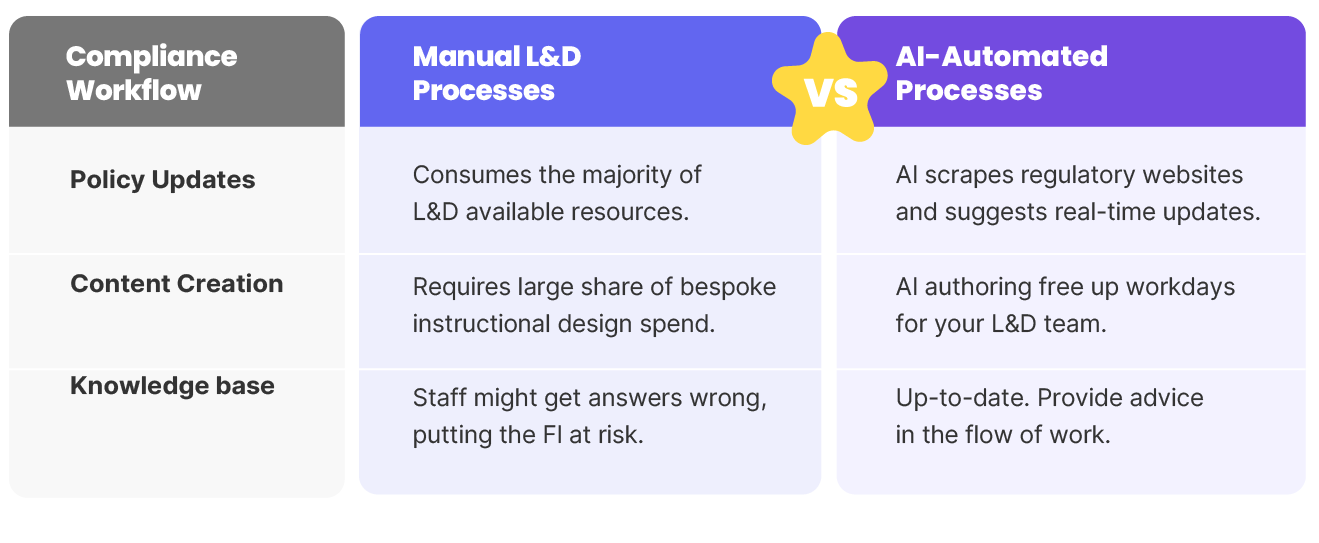
Compliance training consumes a ton of banks’ and credit unions’ L&D resources, leaving little time to roll out training programs that build revenue-driving skills. But AI can help shoulder some of the compliance load. AI agents can actively scrape the web for regulatory updates, and AI authoring tools can help you update compliance training in minutes, lowering compliance risk while reclaiming thousands of hours.
As we all know, the number one non-negotiable for your L&D team is compliance. Because financial institutions have to adhere to a complex web of both federal and state-level regulations, training teams are often consumed by compliance. The result? There's not a lot of time left to train staff on the knowledge and skills that will actually grow the business, making L&D look like an expense rather than a revenue driver.
Here’s where AI can help; AI tools can actually scrape regulatory body websites to pull in any changes the moment they happen. When a regulation shifts, the AI analyzes it and automatically suggests updates to both your training content and your internal knowledge base. It then sends an alert straight to your training team saying, "Here are the modules impacted, please review and approve them". It takes all that manual grunt work out of the compliance piece, keeping you audit-ready without draining your L&D resources.
Compliance Workflows: Manual L&D Processes vs. AI Automation
Part 4
Practicing for Risk: AI Simulations for Fraud Prevention
As fraud patterns rapidly evolve, traditional static training leaves frontline staff completely unprepared for real-world threats. AI simulations allow staff to safely practice high-risk scenarios with AI-generated fraudsters, instantly improving their ability to spot red flags and decreasing actual fraud incidents.
Financial institutions operate within a complicated industry where there’s considerable risk. You're dealing with people's finances, you've got lots of PI, and there’s heavy regulation. Fraud prevention is one area where AI can seriously help you reduce that risk. Instead of just having staff read about fraud, you can build AI simulations where a would-be fraudster tries to get them to enable a fraudulent act. Staff have to guide the conversation and get rated on how well they do, allowing them to practice those real risk situations safely. And as new fraud emerges, the AI engine pushes updated awareness training directly to the relevant staff based on AI-curated case studies from actual fraud patterns.
Fraud tactics are evolving faster than ever, and it's become almost impossible for human L&D teams to manually keep pace with every new scheme. But that’s exactly where AI can help. As new fraud schemes emerge you can document them and put them into your AI knowledge base. The knowledge base will provide staff with up-to-date information on current schemes, and you can quickly generate training content to educate both staff and customers.
