

Digital Fluency and Knowledge Management in Frontline Banking
You built a digital fluency program. Is your frontline actually fluent?
Every bank and credit union got the memo. Digital fluency isn't optional anymore. Your tellers, your MSRs and your branch managers all have to promote the digital channels, explain the tech, and troubleshoot it when a customer gets stuck.
So everybody built a program. Nearly 9 in 10 institutions have now fully or partially rolled one out.
Here's the part nobody wants to say out loud: having a digital fluency program and having a fluent frontline are two different things.
We wanted to know how big that gap really is, so we partnered with Future Branches Insights to go and ask. They surveyed 100 leaders, a quarter of them C-suite, more than half at institutions holding $20 billion or more in assets, from global banks down to community credit unions. Their questions, their respondents. We sponsored the research and then got out of the way.
What 100 banking leaders told Future Branches Insights
-
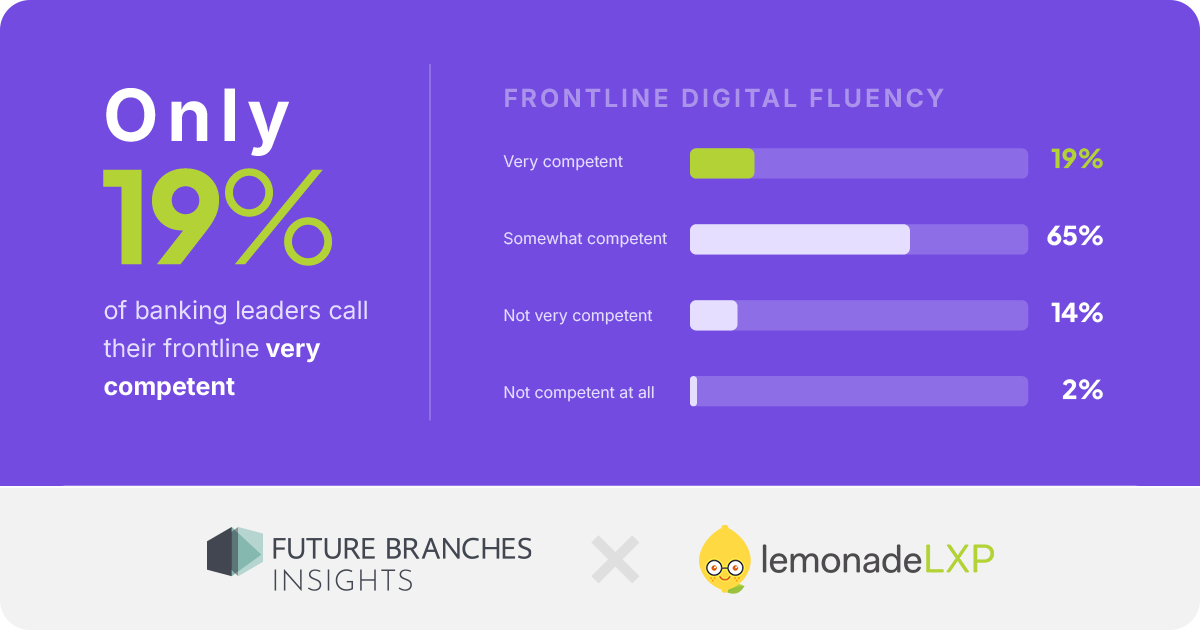
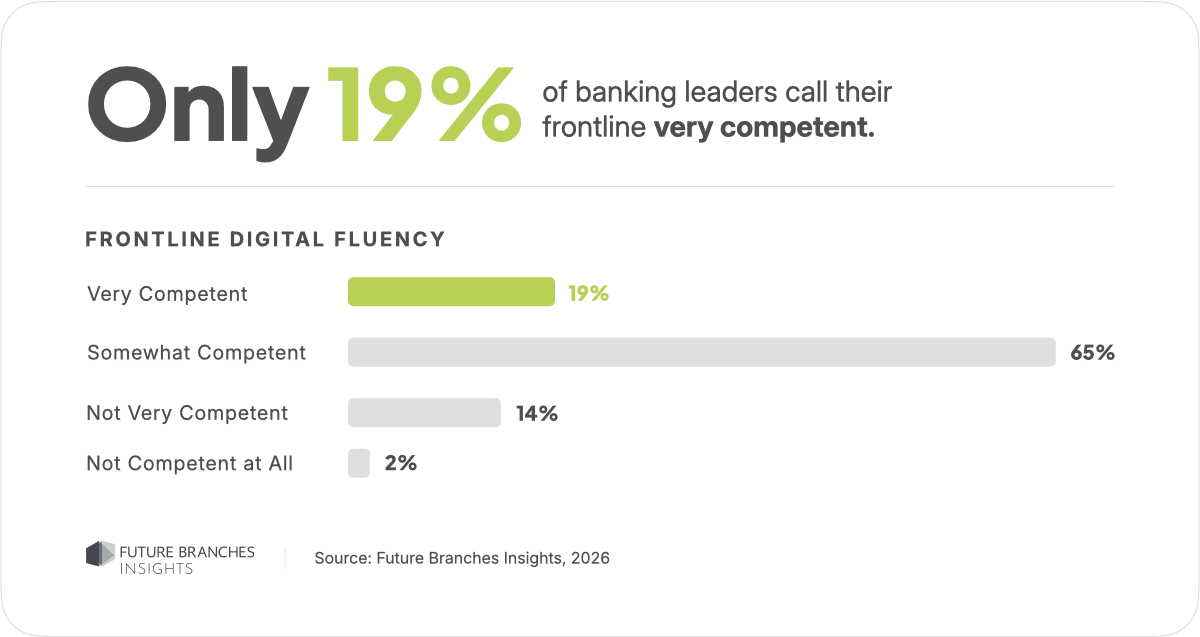
65% say their frontline's digital fluency is only somewhat competent
-
89% have fully or partially implemented a digital fluency program
-
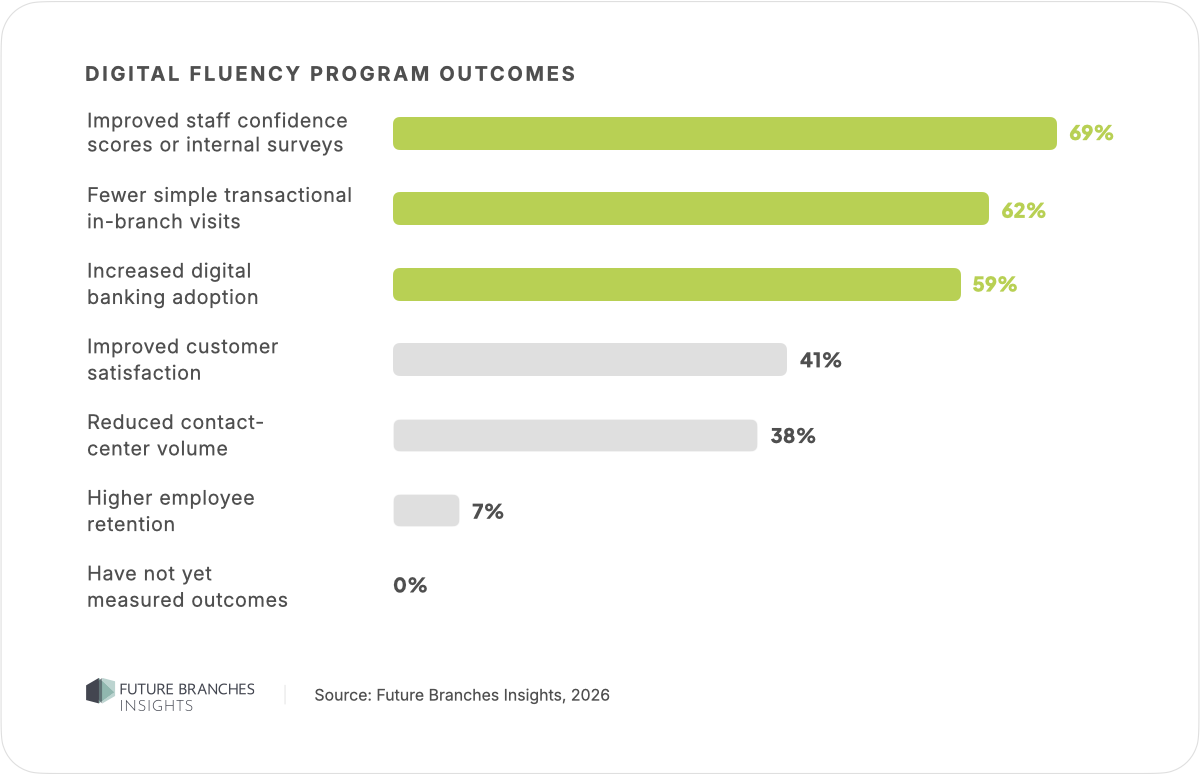
69% of those who fully implemented one say staff confidence improved
-
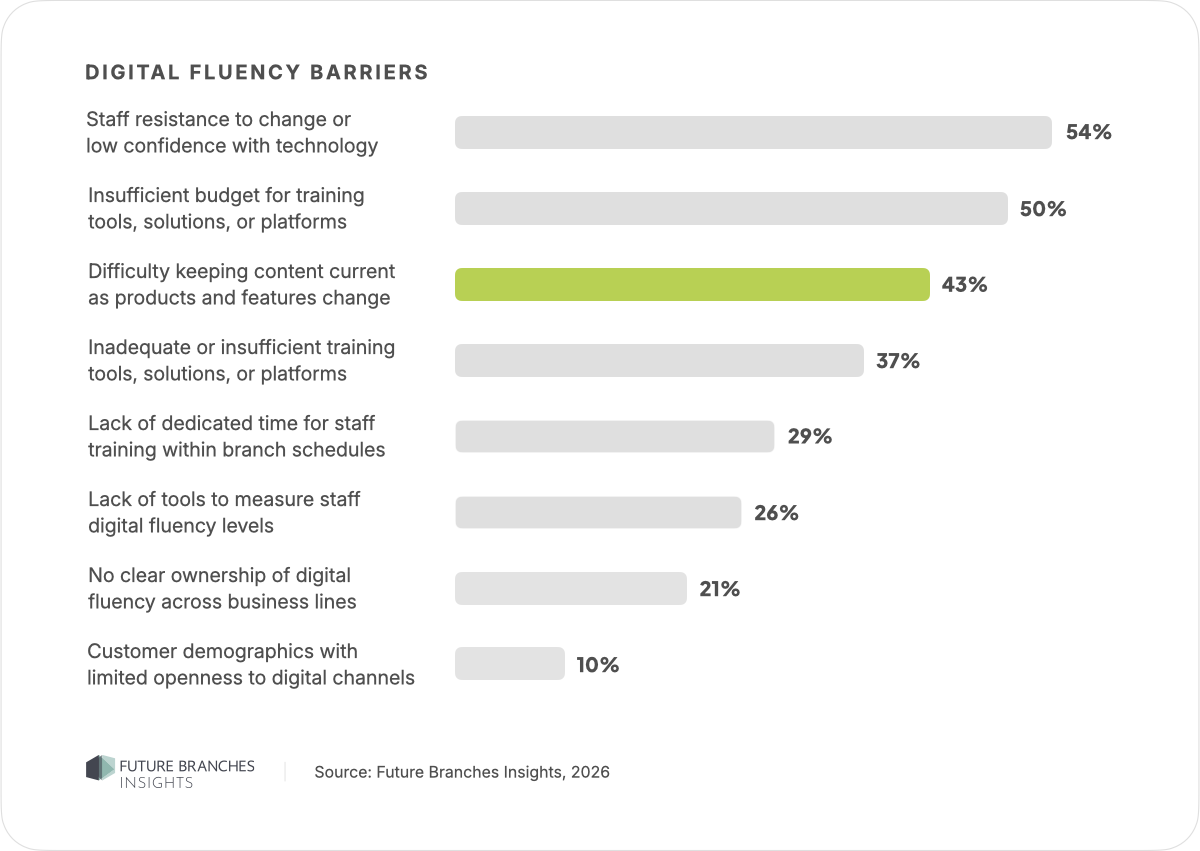
54% name staff resistance or low confidence with technology as a barrier
-
41% run a unified platform for employee and customer education, an equal 41% run separate systems
-
78% say frontline staff's ability to promote and explain digital tools is critical or very important to digital ROI
Source: Digital Fluency and Knowledge Management in Frontline Banking, Future Branches Insights, 2026
Read the first line against the last. Only 19% of leaders will call their frontline very competent, and 78% say their whole return on digital rides on those same people explaining it.
The people you're counting on to monetise digital are the people you haven't finished training, because the build being done doesn't mean the return is.
“The gap between launching digital banking tools and achieving adoption lies in the frontline conversation.”
Pilots are where fluency goes to die
Nearly 9 in 10 have a program. Only 29% have finished one.
Sixty percent are partially implemented or still piloting. Twice as many stuck mid-rollout as have crossed the line. Future Branches is blunt about what that costs.
“Full implementation, not activity, is what separates institutions with strong outcomes.”
Because among the ones who finished, the results aren't marginal. Sixty-nine percent report stronger staff confidence, 62% fewer routine transactional visits at the counter, and 59% report customers actually adopting the digital tools.
Read that as a P&L, not a training report. Institutions that got there stopped piloting.
The challenge nobody budgeted for
So what's actually in the way? It's not that leaders don't see the problem. It's not even the tech.
More than half point to staff resistance and low confidence as the wall they keep hitting. An almost equal number say they don't have the budget to fix it properly. Two very different problems, and most institutions are fighting both at once.
But the third one is the one that quietly kills programs: 43% can't keep training current as products change.
Think about that. Your digital banking platform ships continuously, so training built for the version you launched on is wrong within a quarter. Add the 29% with no dedicated training time inside branch schedules and there's the real constraint — content that has to be rebuilt constantly, by people who have no hours to spare.
That's a tooling problem, not a discipline problem. AI content creation turns an approved policy or release note into interactive training in about eight minutes, then regenerates it from the source when the source changes, so training tracks the product instead of trailing it.
Not every training dollar works the same
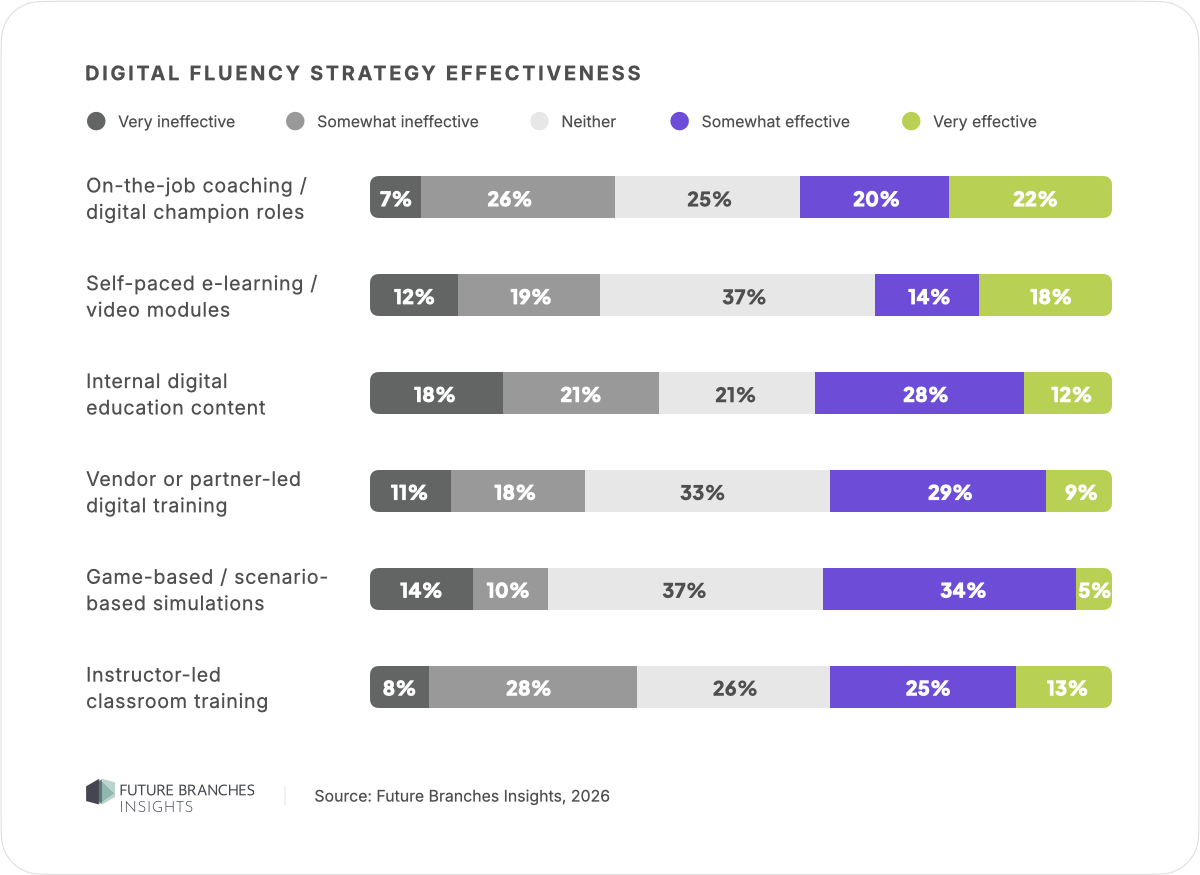
Future Branches also asked leaders to rate six ways institutions are trying to build fluency: classroom sessions, e-learning modules, vendor-led training, game-based simulations and a couple of others.
No single approach ran away with it. But one came out clearly last, and it's the one most training budgets are still built around.
Instructor-led classroom training. Nine percent called it very effective. Forty percent called it somewhat or very ineffective. More leaders think the classroom actively fails than think it works.
“Peer coaching appears to translate more directly into day-to-day fluency than one-time training events.”
Here's what one of their respondents said an ideal program would do:
“Build a peer support culture where experienced employees guide others and tackle everyday digital challenges at work”
That's why 21% are standing up "digital champion" roles this year. The catch is that peer coaching doesn't scale on goodwill, every hour a branch manager spends coaching is an hour off the floor, which is why those programs thin out about three months in. Game-based learning keeps the reinforcement running without burning your best people: 80–95% completion rates, against the 40–60% of traditional eLearning.
What leaders actually want
Asked to describe an ideal program, one VP of Digital at a regional bank didn't hesitate.
“Include real life simulation exercises that feel like actual branch situations so staff can practice without pressure.”
That is not our marketing copy. That's a banking executive describing what he wants, unprompted, to a researcher who wasn't selling him anything.
It's also, almost word for word, the product spec for AI Voice Conversations. Your employee holds a live voice conversation with an AI customer persona, gets scored against your own rubric, and goes again. Real branch situations. No pressure. No member on the other end of the practice run.
“What Lemonade does through gamification is create excitement around training. People actually want to log on and do it.”
Half the industry is teaching the same thing twice
This one deserves its own section, because almost nobody frames it as a problem.
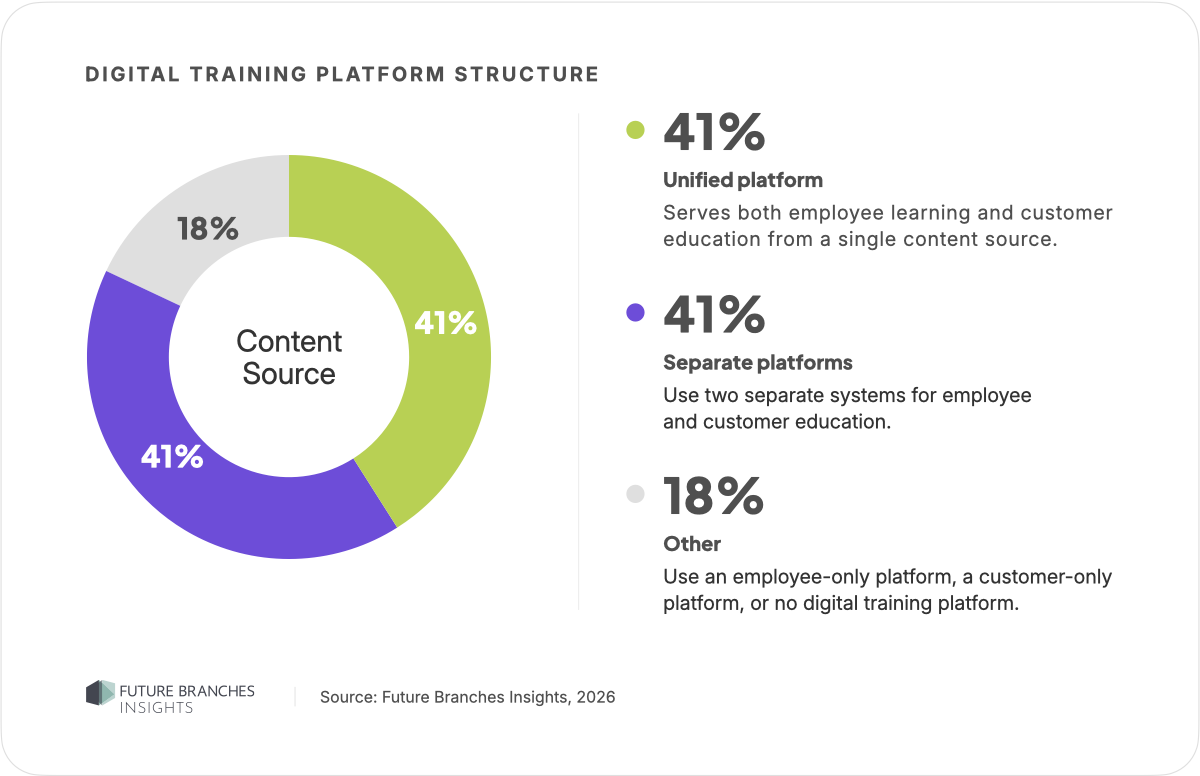
Future Branches Insights asked whether their platform serves employee learning and customer education from one unified content source. Forty-one percent said yes. An identical 41% run two separate systems. Another 15% have something for staff and nothing at all for customers.
So roughly six in ten institutions are writing two explanations of the same digital feature, on two systems, maintained by two teams, drifting apart from the day they publish. But the teller's walkthrough of mobile deposit and the member's walkthrough of mobile deposit are the same walkthrough. Build it twice and eventually the two disagree. Guess who's standing there when they do.
Their respondents were already circling the fix:
“Learning should be motivated by customer needs and common service scenarios rather than generic training content.”
Build it once, from the customer's actual scenario, and publish it to both. That's Customer Academy, one guided walkthrough of your digital banking feature, branded, narrated, localized, deployed to staff and customers from a single source.
One Nevada Credit Union ran that pattern through a Q2 conversion, walkthroughs built and adjusted during implementation instead of after it.
What One Nevada came out with
-
87% of members using digital banking
-
92% e-statement penetration
-
The post-launch call spike they'd budgeted for never fully landed
-
"The trainer was taken aback by how much we already knew." — Patrick Scoggins, One Nevada Credit Union
Everyone measures. Almost nobody measures what matters.
Seventy-three percent measure fluency with internal knowledge assessments or certifications. Only 6% have no method at all. So measurement isn't the gap, interpretation is.
A quarter of leaders still say they lack the tools to measure staff fluency, and only 4% named tracking it against defined KPIs as a priority this year. You can hold a full set of assessment scores and still not answer the question your CFO will ask: did the training change the business?
Answering it means joining two datasets that usually never meet: what your staff know, and what your branches did. That's the job analytics and reporting is built for.
What shows up when you connect learning data to business data
-
Branches scoring above 80% on knowledge run +12.4% on revenue
-
Teams with stronger retention run +9 points on NPS
-
High-performing training teams log 38% fewer compliance errors
And note what Future Branches didn't find. Of the institutions that fully implemented, zero percent said they hadn't measured outcomes. The ones who finish, measure.
Two weeks per feature, in a market that ships weekly
One number reframes the whole thing. Asked how fast they can get frontline staff trained and confident enough to promote and support a new digital tool, 62% of leaders said one to two weeks. Another 26% said a month or more.
Two weeks is a respectable answer to the wrong question. It's the honest cost of a training cycle: build, schedule, deliver, assess. But digital banking doesn't ship on a two-week cadence.
Their respondents know it. Here's a VP of Retail Banking, again describing a product rather than a training programme:
“Add small guides to help inside the actual system so employees can learn while working, without needing to switch between tools or manuals.”
That's InsightAI. A teller facing an unfamiliar question doesn't need a course, she needs the answer, from an approved source, while the customer is still standing there, without leaving the screen she's on. Every answer traceable back to the source in one click.
Training for what your staff have to internalize. Instant answers for the long tail no curriculum will ever cover.
The Final Squeeze
Strip the research down and Future Branches argues four things: coach on the job, give staff a safe place to practise before they face a customer, measure confidence and customer outcomes instead of course completions, and finish the implementation instead of piloting forever.
“Building digital fluency is less about introducing new technology and more about giving staff structure, practice, and support.”
Which is why the top priority leaders named for the next twelve months isn't a training initiative at all. It's a system: 66% named onboarding a digital learning solution to manage training and build capability, ahead of developing content and redesigning branch workflows.
Four independent findings, four things their own respondents asked for by name, and every one of them is something we already built. That's not a coincidence, it's why we sponsored the research in the first place. Structure, practice and support aren't a campaign you run. They're something you install.
Cornerstone Bank is what installed looks like from the other side.
Cornerstone Bank, after full implementation
-
91% lift in product recommendations
-
50% faster time-to-proficiency
-
90% less manager coaching time
-
56% drop in staff attrition
Where does your program actually rank?
Digital Fluency and Knowledge Management in Frontline Banking lays out where 100 of your peers stand right now: what's working, what's stalling, where the budget is going, and how the furthest-ahead institutions are proving ROI. Sixteen pages from Future Branches Insights, including the full data on all six strategies and all four Practitioner Perspectives sections in leaders' own words.
If you want to know how your program compares, this is the one to read.
